


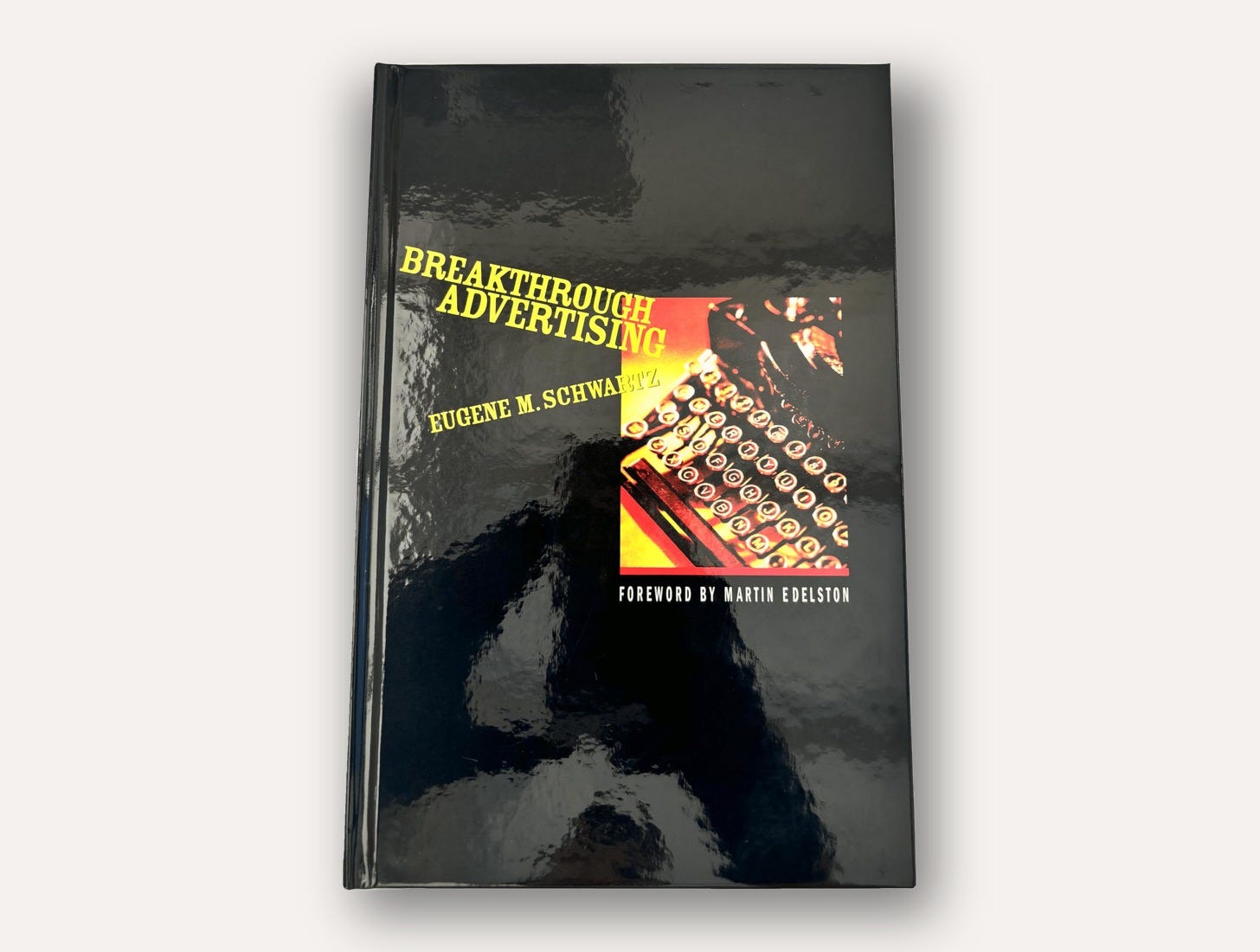
Just finished reading Breakthrough Advertising by Eugene Schwartz. It was published 60 years ago, and it proved more useful than almost anything written about marketing since.
Eugene Schwartz was a mail order copywriter. Every ad he wrote had to pay for itself in orders. The book sold a few thousand copies, went out of print, and by the early 2000s used copies sold for more than $900. It is now back in print, and in 2021 one reader still paid $1,025 for a used copy.
The book is dense, and its examples are soap, cigarettes and correspondence courses. The lessons apply to every ad, landing page and email you will write this year. Here is the short version, each lesson headed by a line from the book.
“Copy cannot create desire”
Copy cannot create desire for a product. It can only take the hopes, dreams, fears and desires that already exist in the hearts of millions of people, and focus those already-existing desires onto a particular product.
This is the foundation of the book. Desire comes from the market. Your job is to find it and point it at your product.
Schwartz's example comes from Detroit. In the mid-1950s, Americans were rating each other's cars by horsepower. Ford chose to spend millions of dollars selling safety instead, while Chevrolet sold power and widened its lead to 190,000 cars in 1956. The next year, Ford advertised the most powerful engines in its history.
Apply it: Stop trying to make people want something new. Find what they already want, in their own words: reviews, support emails, search terms, the comments under competitors' ads.
“Only one will fit the lock”
Every product satisfies several desires. A headline can carry one. Schwartz scores each on three dimensions:
Urgency: how badly people want it.
Staying power: whether the want keeps coming back.
Scope: how many people share it.
Pick the desire that scores highest on all three. Then sell what the product does, never what it is made of. People do not buy “the steel in a car,” he wrote. (Same idea as our Super Mario insight: your product is who your customer becomes.)
Apply it: List every desire your product satisfies, score each 1 to 5 on the three dimensions, and lead every ad with the winner.
“Your ad always begins with your market”
Before writing a word, ask how much your prospect already knows. Schwartz describes five stages of awareness, separated by walls. A headline that works on one side of a wall fails on the other.
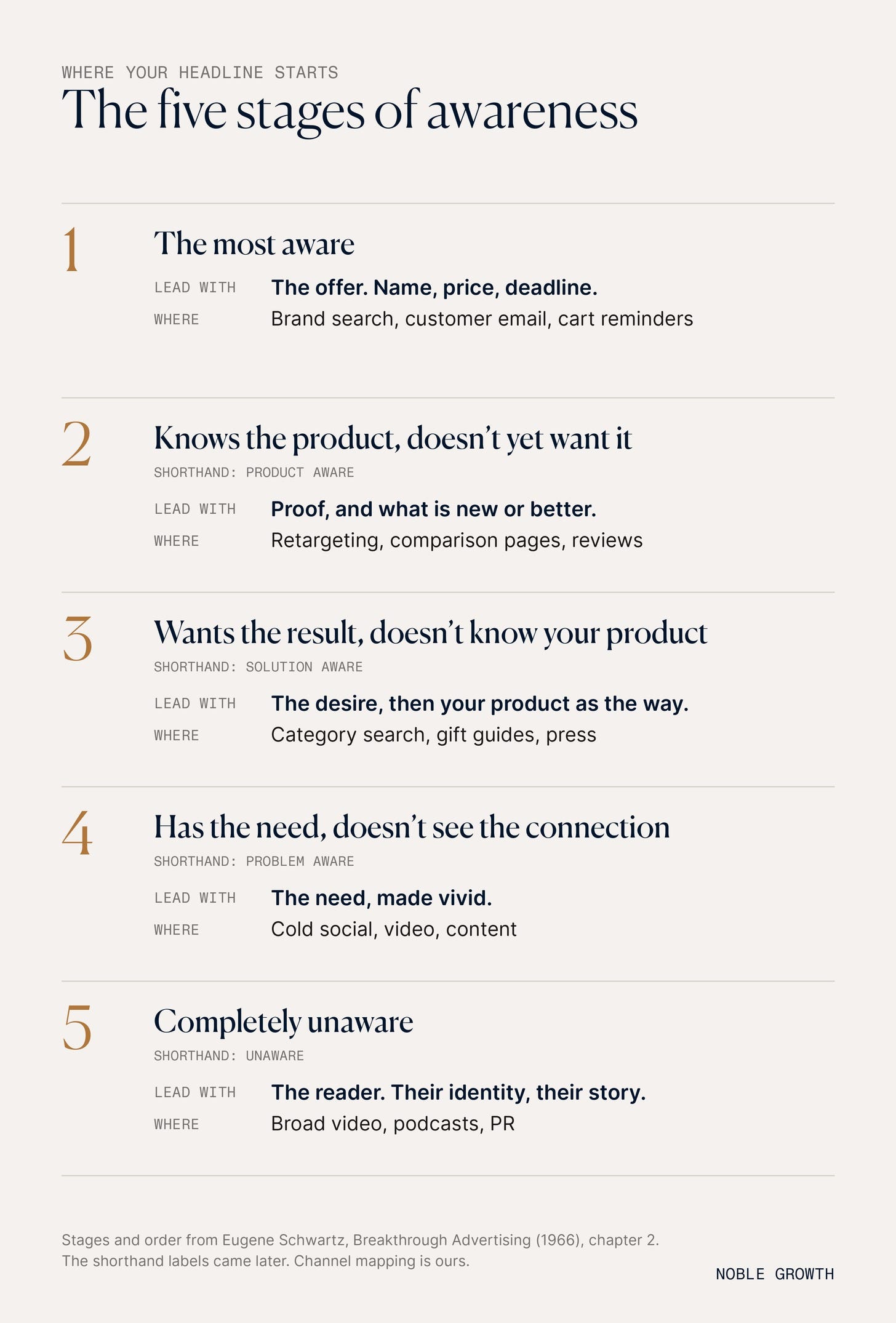
Note the order. Schwartz starts at the top, with the most aware, and treats each stage as a separate market. Many charts online flip it into a pyramid, and labels like problem aware and solution aware came later.
The less aware the market, the less the headline should say about the product. For the unaware, Schwartz leaves out the price, the name and even the claim. What is left? “Your market, of course!”
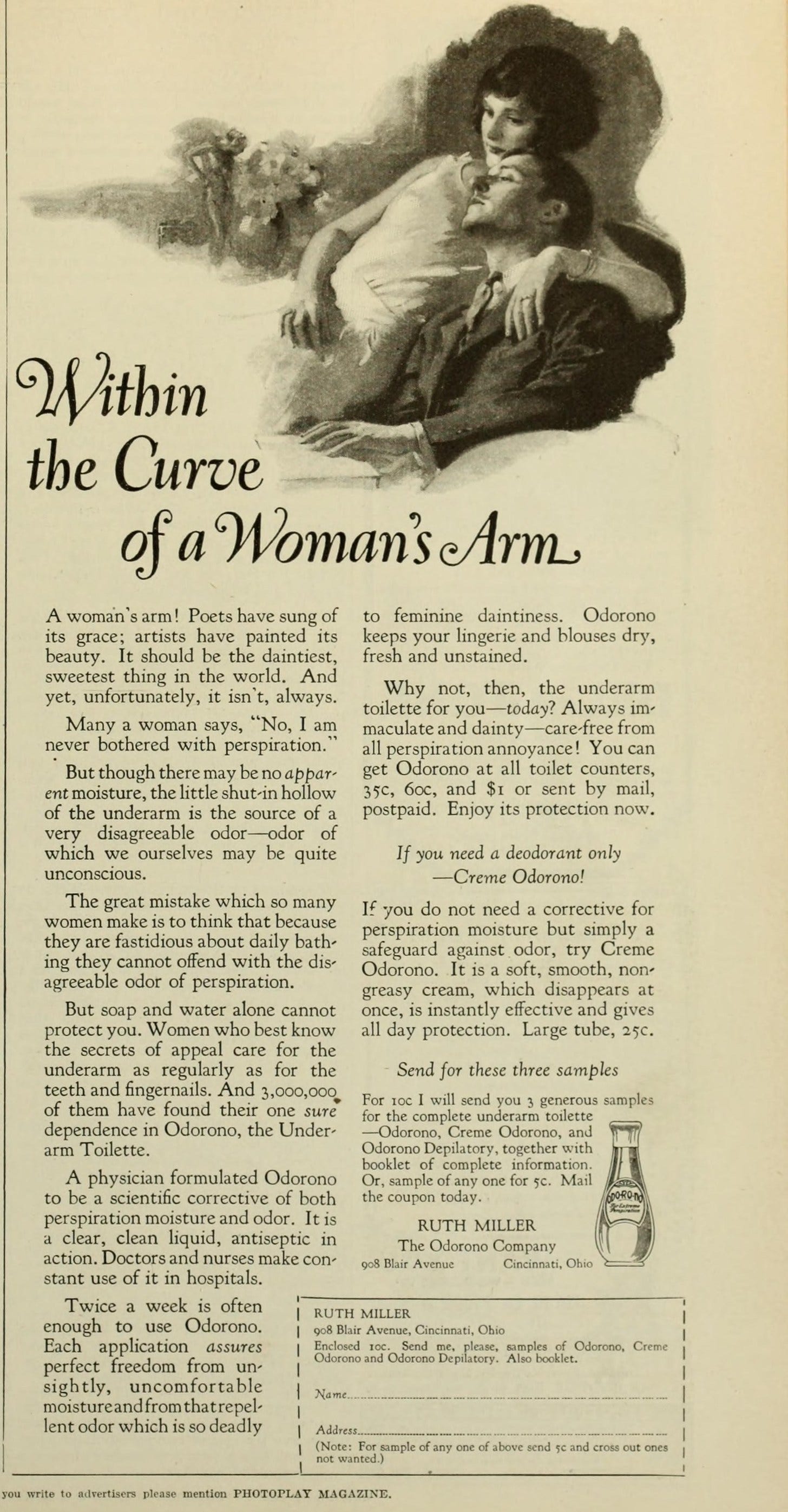
Odorono, a 1919 deodorant, could not print the word perspiration in a headline. So it opened with an image everyone accepted, “Within the Curve of a Woman’s Arm,” and reached the problem a few paragraphs later. Sales rose 112 percent the following year, according to the agency's records, even as some 200 readers of Ladies' Home Journal canceled their subscriptions in protest (Smithsonian).
Apply it: Write a different first line for each audience. Brand search gets the offer. Retargeting gets proof. Cold audiences get a line about themselves. A discount in a cold ad speaks to a customer who does not exist yet.
“How many products have been there before you?”
Your market has also heard from your competitors. Schwartz calls this its stage of sophistication, and each stage needs a different kind of headline.
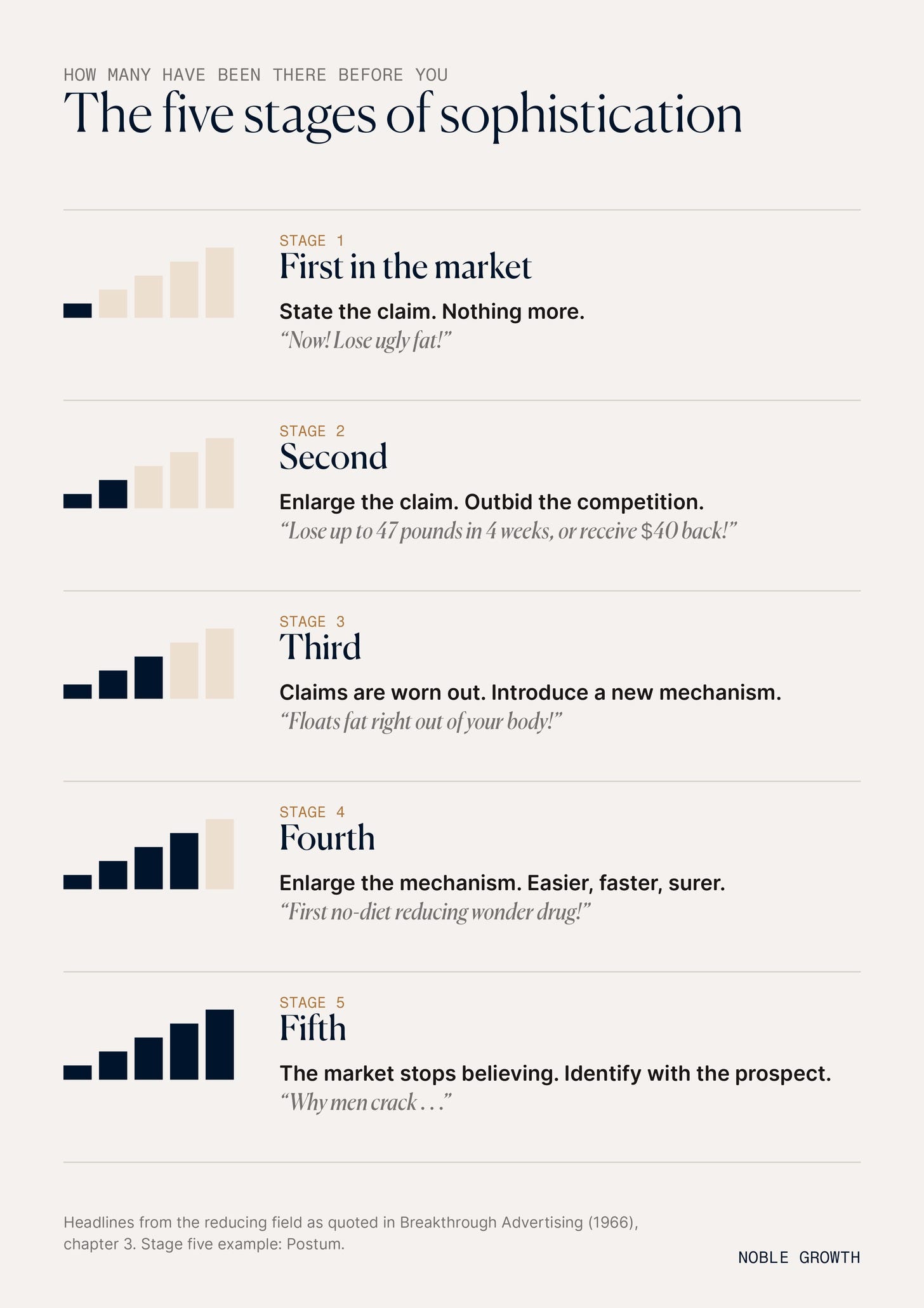
Most categories today are at stage three or beyond. Every claim has been made and inflated, so buyers need a new reason to believe. “Here the emphasis shifts from what the product does to HOW it works.” Schwartz called it a new mechanism. The popular phrase unique mechanism came much later.
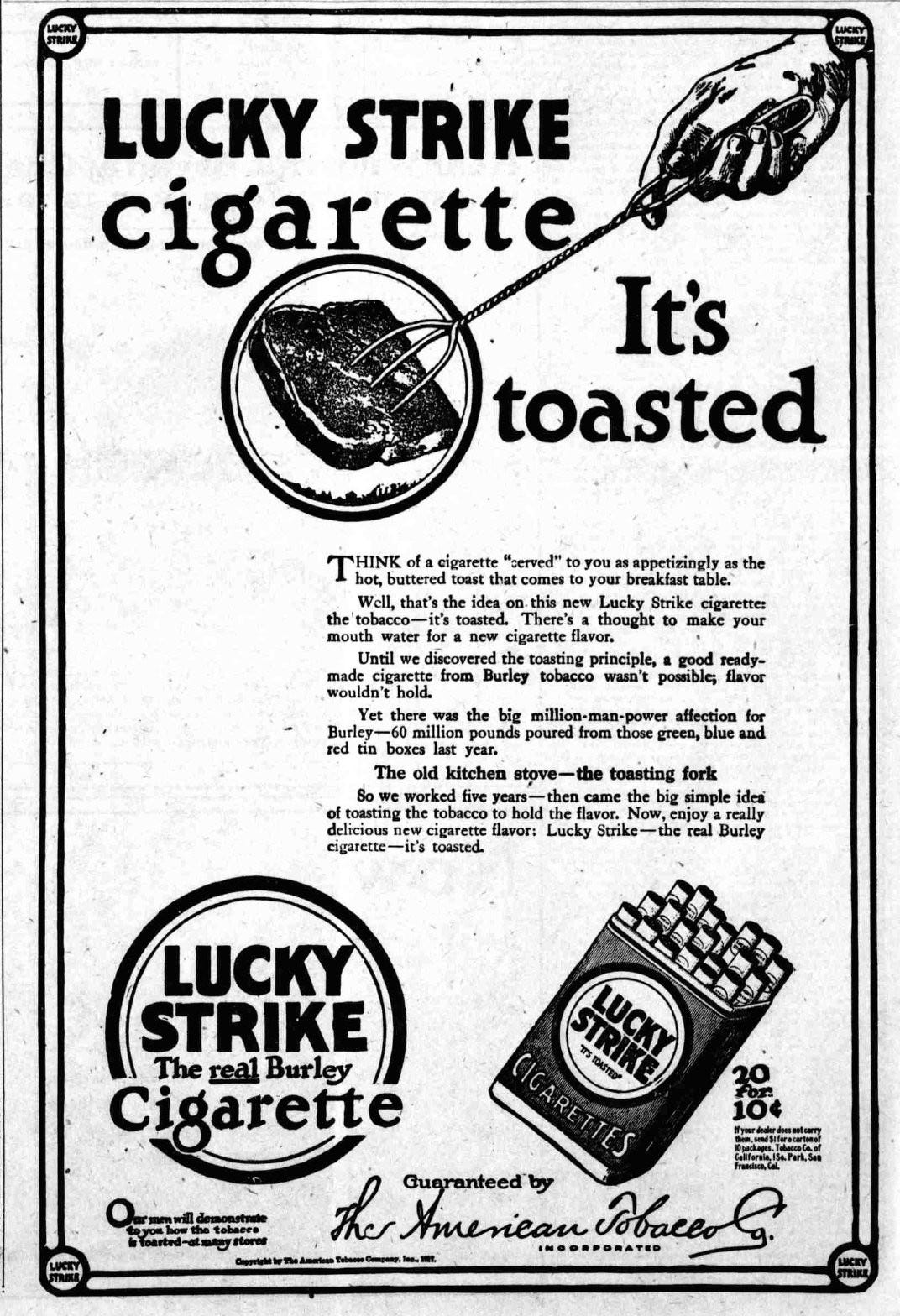
The weight loss market Schwartz used as his example is still running the cycle. By late 2025, nearly one in five American adults said they had used a GLP-1 drug, most often taken as a weekly injection, according to KFF. Same promise, new mechanism.
Apply it: Read the last 50 ads in your category in the Meta Ad Library. If they all make your claim, a bigger number will not help. Name your mechanism: the specific reason your product works.
“Your headline has only one job”
That job, he wrote, is “to stop your prospect and compel him to read the second sentence of your ad.” Every sentence after it has the same job.
A few words carry the whole ad: “These five or ten words will make up about 90% of the value of your ad.” His 38 ways to strengthen a headline include:
Measure it: “Who ever heard of 17,000 blooms from a single plant?”
Demonstrate it: “At 60 miles an hour the loudest noise in this new Rolls-Royce comes from the electric clock.”
Dramatize the result: “They laughed when I sat down at the piano. But when I started to play!”
State a paradox: “How a bald-headed barber saved my hair.”
Ask a question: “Who else wants a whiter wash, with no hard work?”
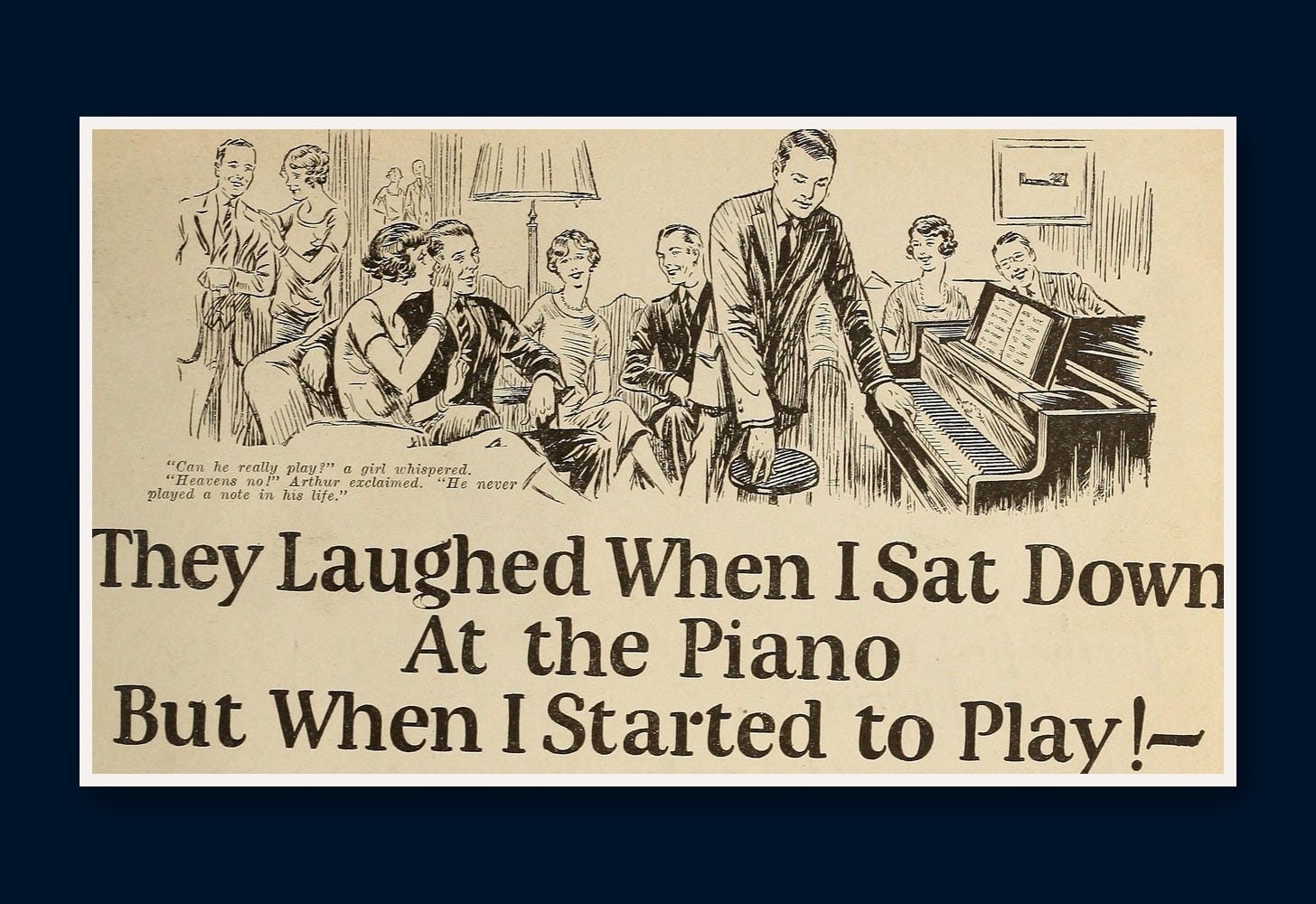
Apply it: Write 25 headlines before you pick one. Test the best three. The first line of a social ad, the first two seconds of a video and every email subject line are headlines.
“Belief is immutable”
The body of an ad, Schwartz says, works on three parts of the reader's mind: what they want, who they want to be, and what they already believe.
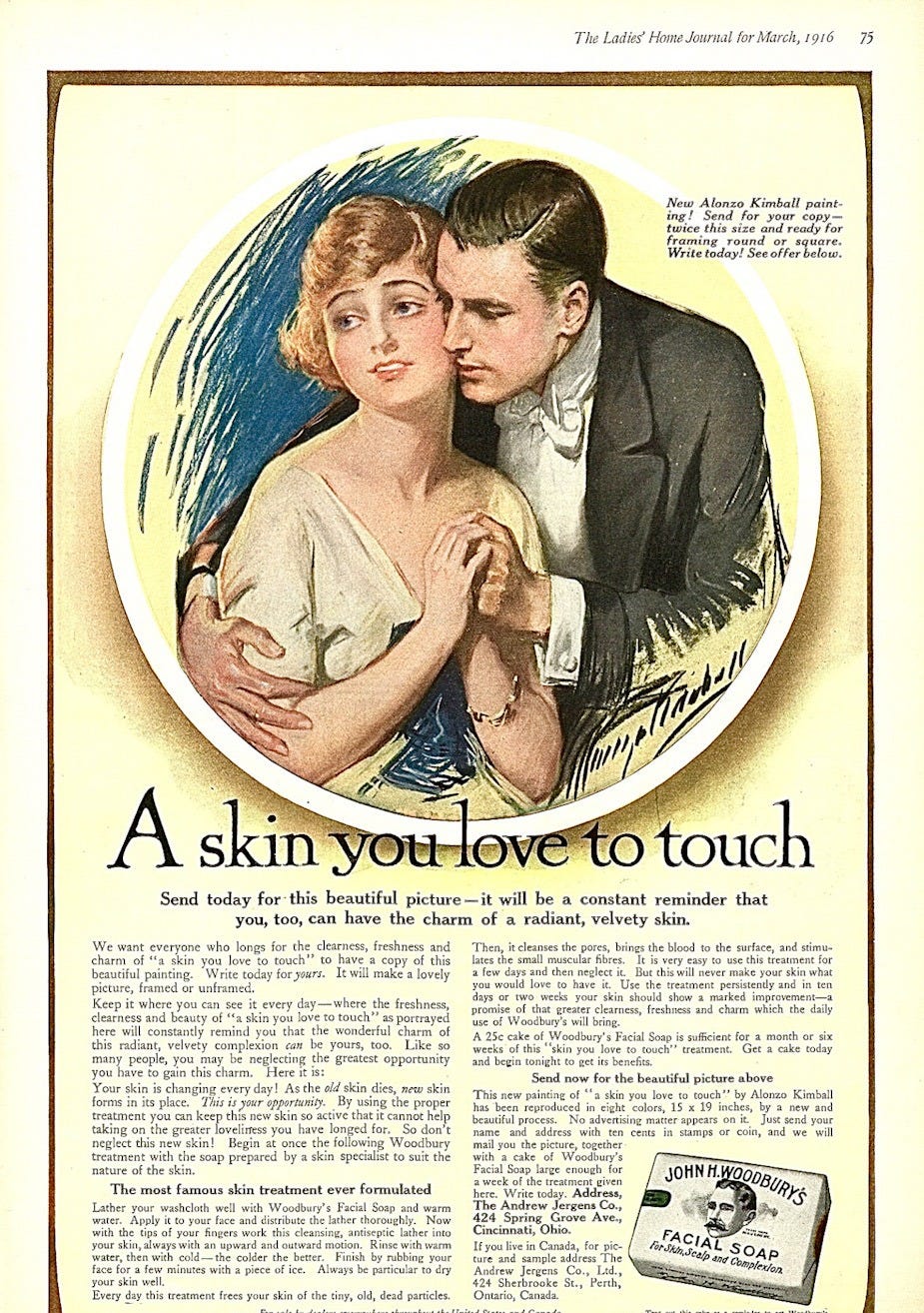
Belief is the strict one:
If you violate your prospect's established beliefs in the slightest degree . . . then nothing you promise him, no matter how appealing, can save your ad.
So you begin “with a statement that will be immediately and entirely accepted” and build a chain of agreement from there. He gives seven techniques for doing it:
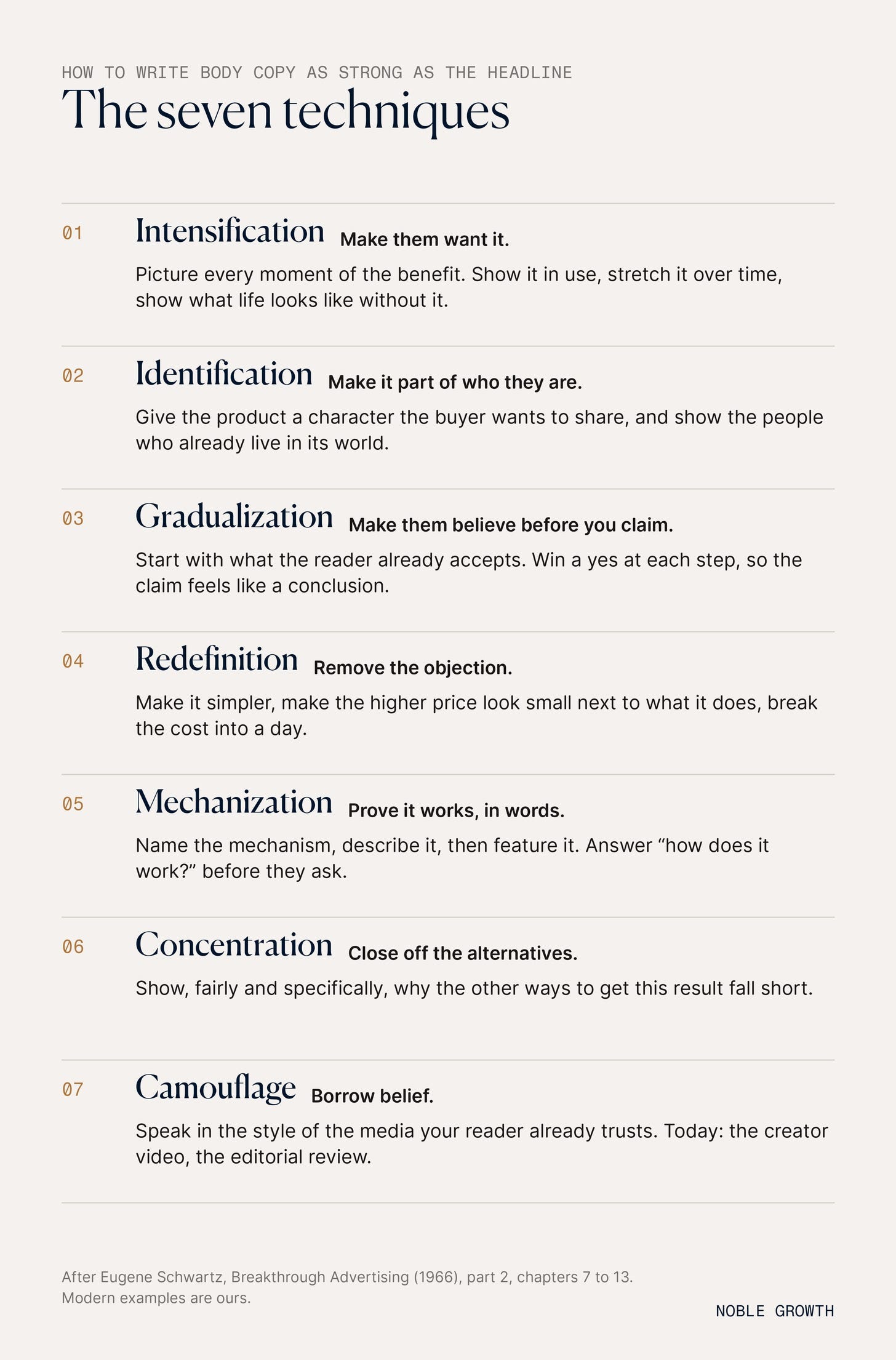
Apply it: Read your best landing page. Does it make the reader picture the result, see themselves in it, and agree with each step before you ask for the sale?
“No formula works twice”
Schwartz ends a book full of frameworks with a warning against them. Copy a winning headline and you get an “Echo Ad.” Every formula solved a problem that has already passed.
“You never step in the same river twice. No market ever stands still.” The ad that won last quarter solved last quarter's market. Keep testing. (More in Why Most Ads Fail.)
“Always shoot for the moon”
That is the book's last line of advice. Here is the whole book as a checklist:
Name the desire your customers already have, in their words.
Pick one that scores highest on urgency, staying power and scope.
Place each audience on the awareness scale.
Count who came before you: claim, bigger claim, mechanism or identity.
Write 25 headlines. Test three.
Build belief one accepted step at a time.
Start over when the market moves.
Copywriter Parris Lampropoulos, as Brian Kurtz tells it, advises reading the first three chapters several times before going on. They hold most of the above.
One note if you go looking for more Schwartz quotes. Two of the most shared lines are not in this book. “Copy is not written. Copy is assembled” has no verified source, and his famous 33-minute writing timer comes from a talk he gave in 1993.
If you want a second set of eyes on which desire your brand should lead with, reach out.
Below, in The Control Room: the one-page brief we fill out before every campaign, how to read your market's stage from your own data, a full worked example, and the reading list Schwartz told every copywriter to buy.