


"Turns out the future does have flying cars." Video: Elon Musk on X, October 15, 2026.
On October 15, at a SpaceX facility, Tesla drove a new Roadster up a ramp that curled overhead until the car hung upside down. It clung there by suction, launched off the end, rolled 180 degrees in midair on jets of compressed air, and landed on its wheels. Production is slated for 2028.
A car that leaves the ground was a punchline for most of our lives. Now it is a livestream.
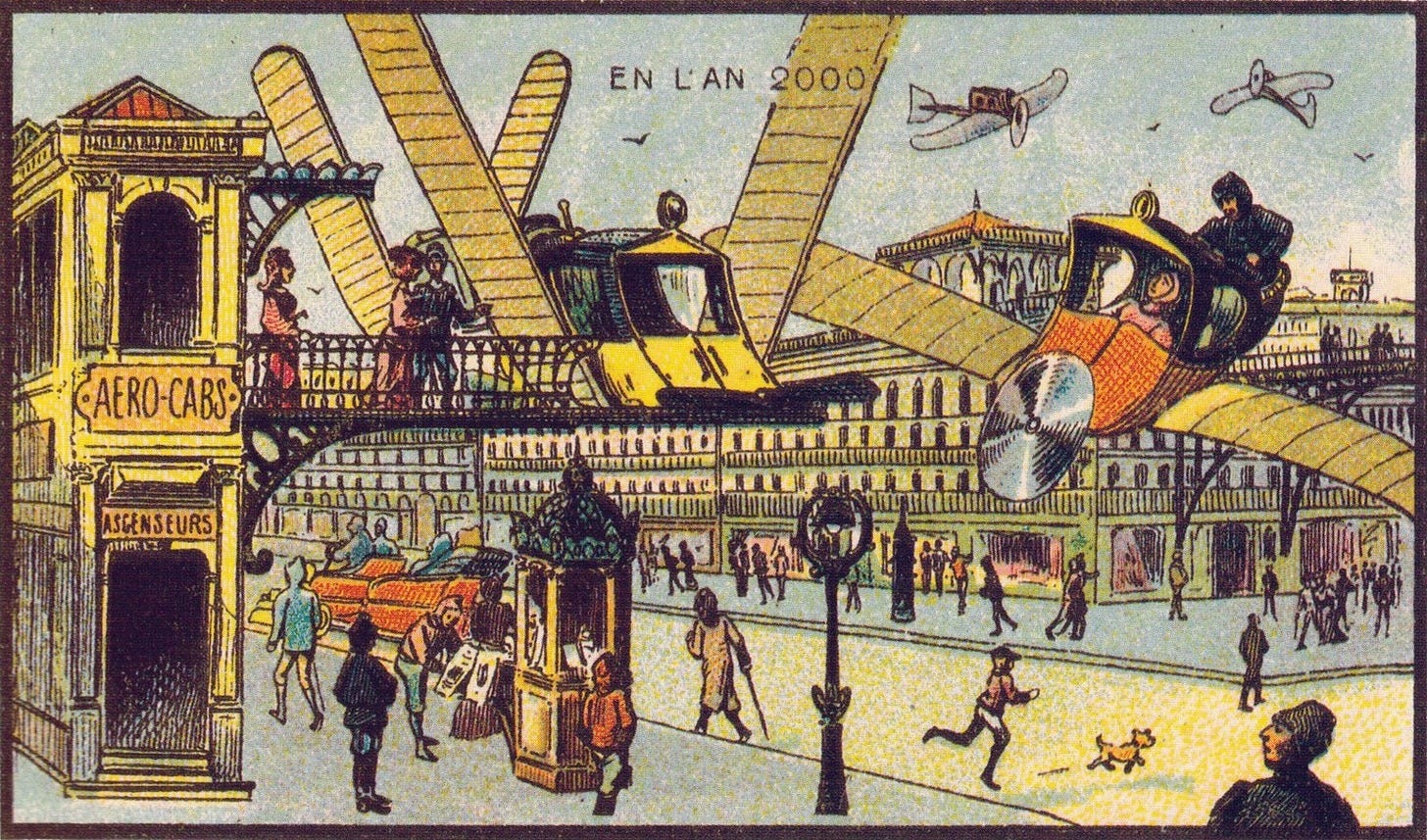
Progress does not arrive evenly. Two days after the Roadster flew, protests across France turned into riots. In Limoges, rioters set fire to the 1883 town hall, and its spire collapsed into the flames. Nearly a century and a half of craftsmanship, gone in a night. Progress is jagged. The same week can deliver a flying car and a burning landmark. The next ten years will see plenty of both.
Meanwhile, new frontier AI models now ship almost every week. Since September, the White House has called them Super Intelligence, or SI, and the name is earning its keep. These systems write production software, run ad accounts, draft legal briefs, and build 3D worlds in an afternoon. Whole categories of software are being rebuilt from scratch by small teams, sometimes by one person plus agents. People have started calling it the SaaSpocalypse. And the pace keeps rising: Anthropic's Claude Duet, an agent that checks in before you ask, is already in limited release, and a Fable 5.5 model is widely expected next.
This article is a realistic look at the next ten years: what they could bring, and how to navigate them.
The software layer is already moving
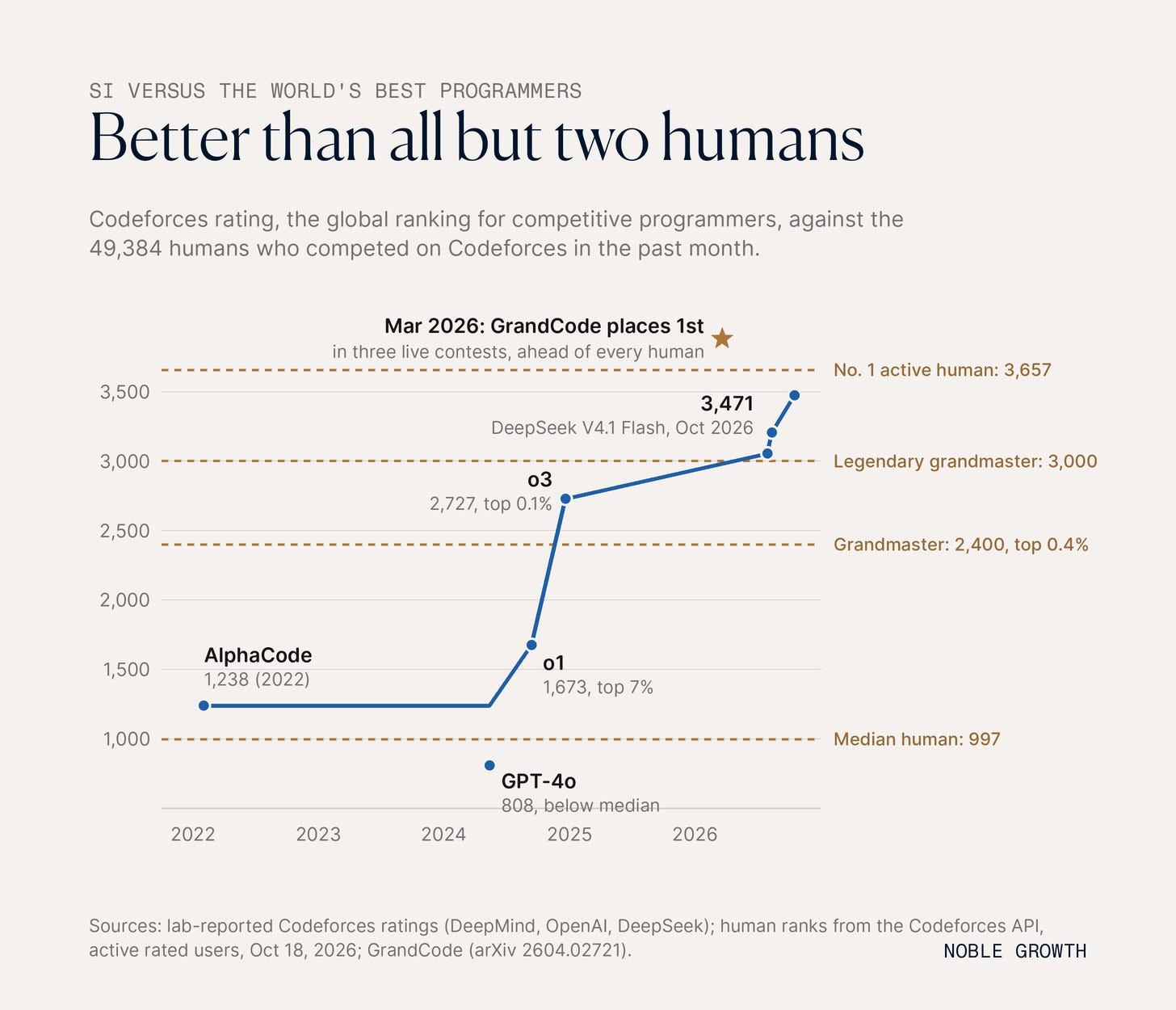
Look at how SI stacks up against the best human programmers. Codeforces ranks competitive programmers worldwide. In 2024, GPT-4o rated 808, below the median human on the site. In October, DeepSeek's newest model reported a rating of 3,471. Of the 49,384 people who competed on Codeforces in the past month, only two rate higher. And in March, an SI system called GrandCode took first place in three live Codeforces contests in a row, ahead of every human in the field.
Longer engineering work tells the same story. METR, an independent lab, found that by April SI agents could finish software tasks that take a skilled human engineer about 17 hours, more than two full workdays, before its tests ran out of tasks hard enough to measure the newest models.
Every product that lives on a screen is now replicable. A feature that took a funded team a year to build can be rebuilt over a weekend. The most nuanced programs, the ones whose complexity used to be their protection, are falling fastest, because complexity is exactly what these models handle well.
The hardware layer is next
In August, at the World Humanoid Robot Games in Beijing, a robot called Tiangong Ultra ran 100 meters in 8.86 seconds. Usain Bolt's world record is 9.58. Then it crashed into the barrier past the finish line, sparks flying from its waist. Both halves of that clip tell you where we are.
Tiangong Ultra, 100 meters in 8.86 seconds. Beijing, August 2026. Video: CGTN.
Robotics is following the same curve, a few years behind. The hard parts are hands, balance, and judgment in messy physical spaces. Balance and judgment are mostly software problems, and software problems are getting solved. Hands are the hardware holdout: motors, sensors, and materials that can match human dexterity. Engineers are making strides on both.
When robotics reaches its tipping point, the disruption reaches the electrician, the framer, and the warehouse just as surely as it reached the developer.
The extreme case
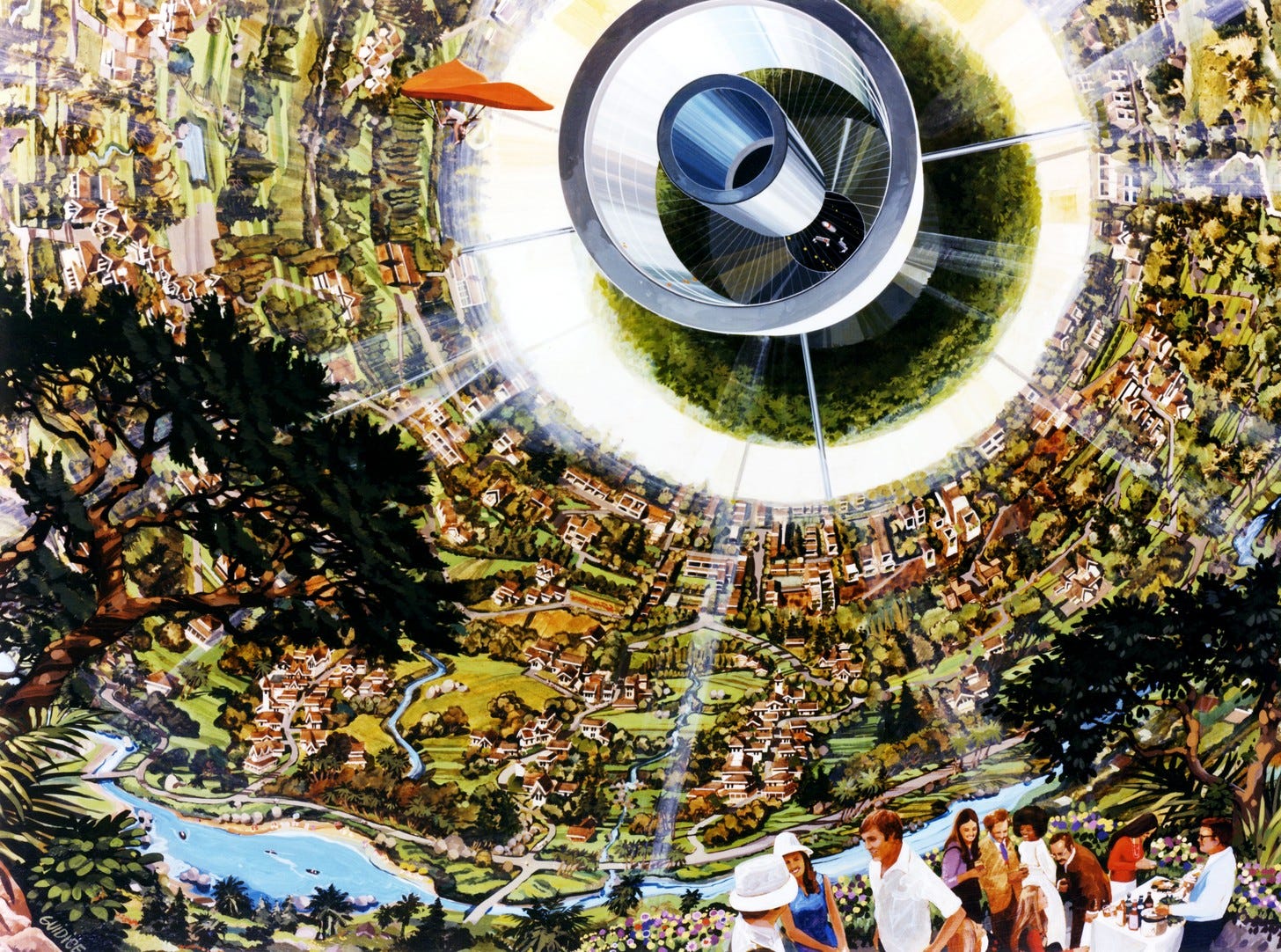
Here is a thought experiment. It describes what could happen, which is different from a forecast.
Suppose SI agents become as competent as the most competent human at every task you can do on a computer. Suppose robots arrive with hands and limbs as capable as ours, running flawless software and doing every job exactly right: faster, with fewer errors, and no need for rest.
In that world, the value of labor as a way to raise your economic standing trends toward zero.
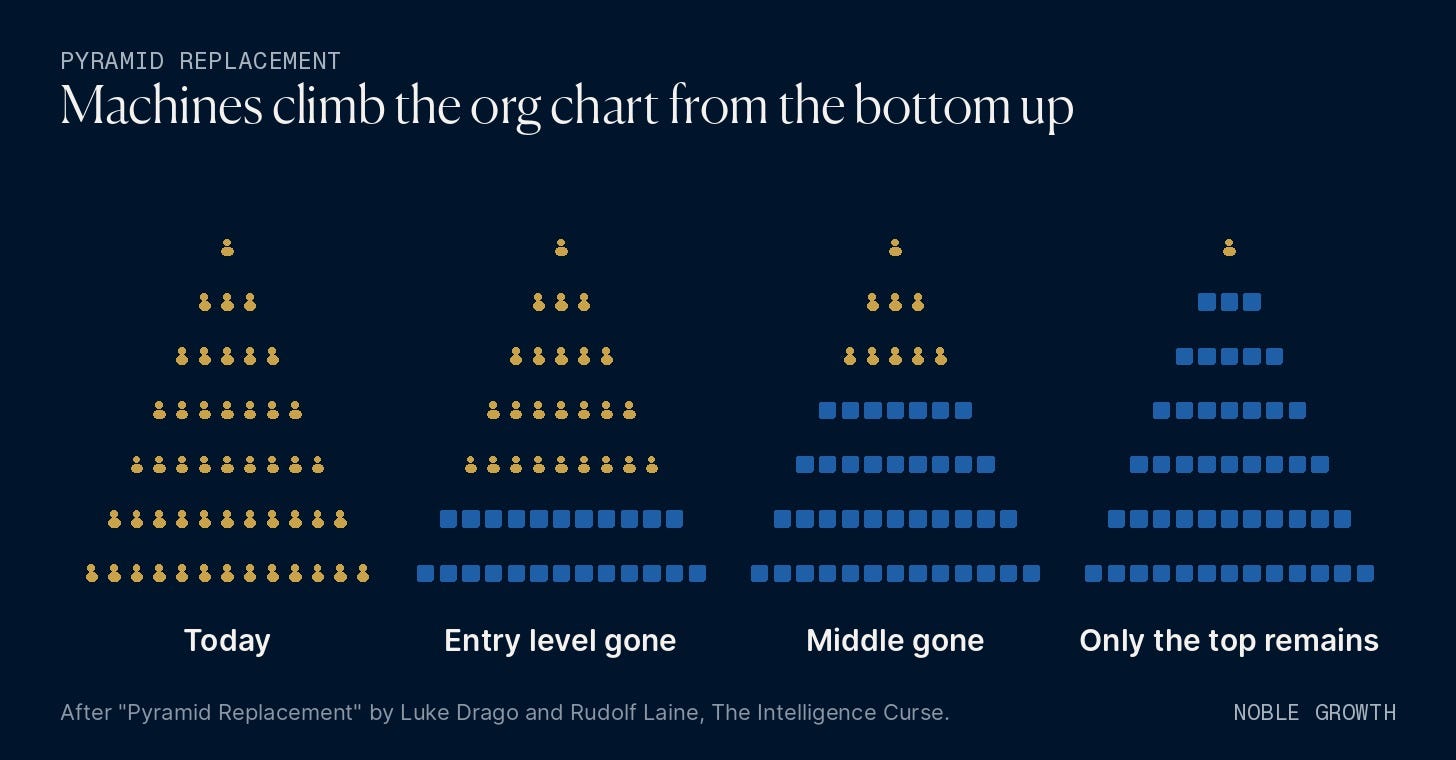
Luke Drago and Rudolf Laine call the path there pyramid replacement. Companies stop hiring at the bottom, and machines climb the org chart one layer at a time until only the top remains.
Picture someone who is already wealthy. They can hire a robot that does everything you can do, only better, at a laptop or on a job site. With enough capital, they hire ten. Then a hundred. Then a thousand. Good luck competing with that.
There will be exceptions. A few savants, imaginative and unorthodox enough to find an angle the machines missed, will still climb by their own effort. They will be the exception.
So the model looks like this:
The value of labor as a lever for wealth creation goes toward zero. The value of capital as a lever for wealth creation goes toward infinity.
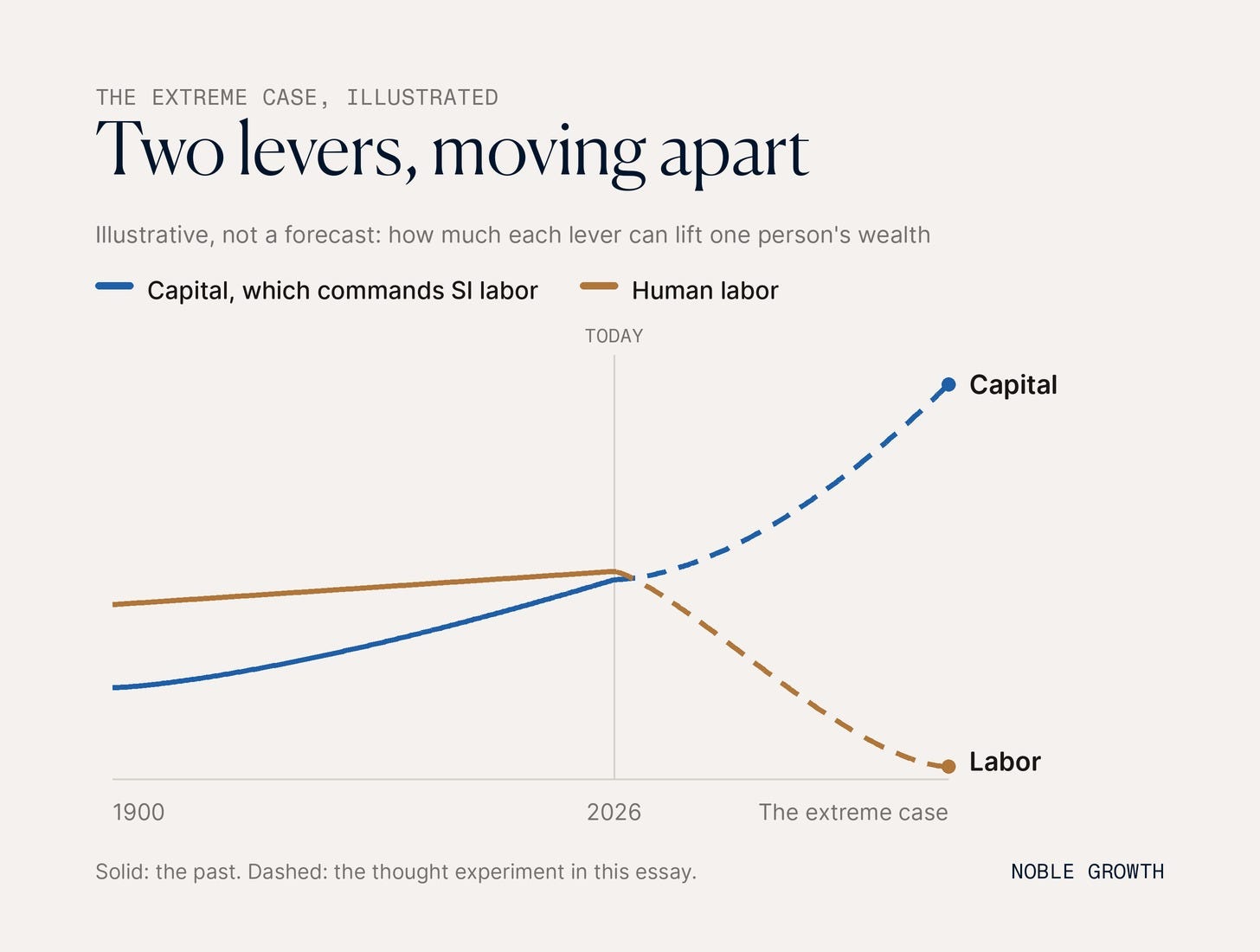
Naval Ravikant counts a third lever beyond labor and capital: products that cost nothing to copy, meaning code and media. Super Intelligence changes both. Code folds into capital, because whoever pays for the compute owns the output. Media gets cheap too, since SI can produce it in endless volume. What stays scarce is attention, and trust in real people, especially the ones you knew before SI arrived. Keep that in mind when we get to distribution.
You can cooperate instead
Here is the good news. You do not have to compete with the machines. You can command them.
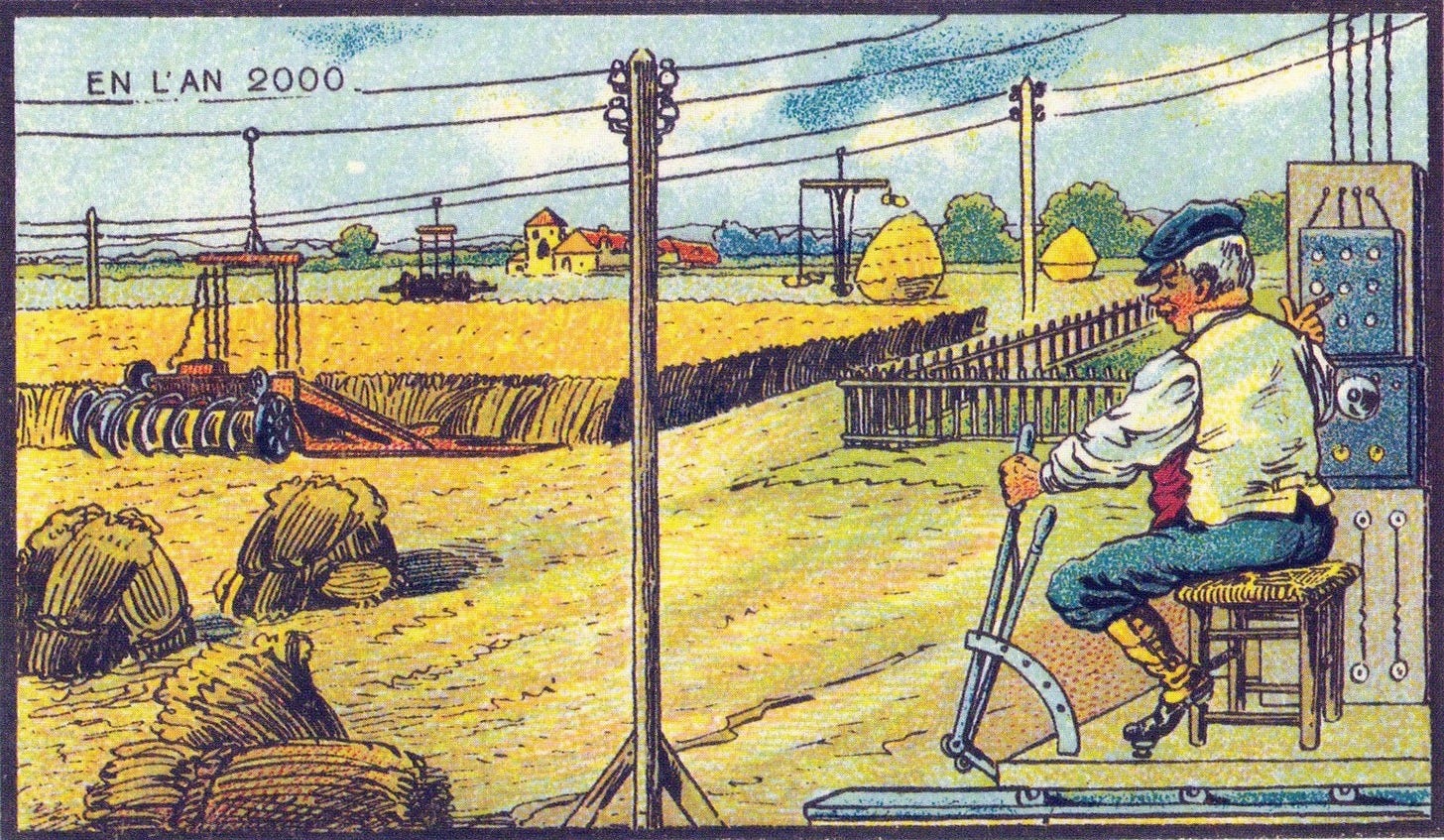
If you build up any scarce, desirable capital before this trend takes hold, you may be able to direct more intelligence and more physical labor than any of your ancestors could have dreamed of. One person with a modest stake could run what used to take a company of hundreds.
Here is what that looks like in dollars. In 2021, $60 bought a million tokens from GPT-3, a model that could not reliably write a working program. Today, $10 buys half a million tokens of output from Claude Opus 5.5, one of the top-ranked models in the world. The price of a given level of intelligence has been falling about tenfold a year.
Point that $10 at a team of SI agents and the math turns strange. A website an agency would have quoted at $100,000 five years ago gets built in an afternoon. An app that once meant $10 million in developer time gets built over a weekend. You can accomplish more with less money than ever before, if you put your capital to work through SI agents.
And if you have not built that capital yourself, a family member, a friend, or a patron in your network who has gathered scarce assets, land for instance, could bring you into their circle on favorable terms. You could be far better off than you are today.
The assets that matter in this model are the scarce ones: land, gold, equities (especially in SI and in the sectors SI depends on and is unlikely to do without), and Bitcoin. Whoever holds them when these trends mature may end up in a better position than they can imagine.
Two ways to spend the next ten years
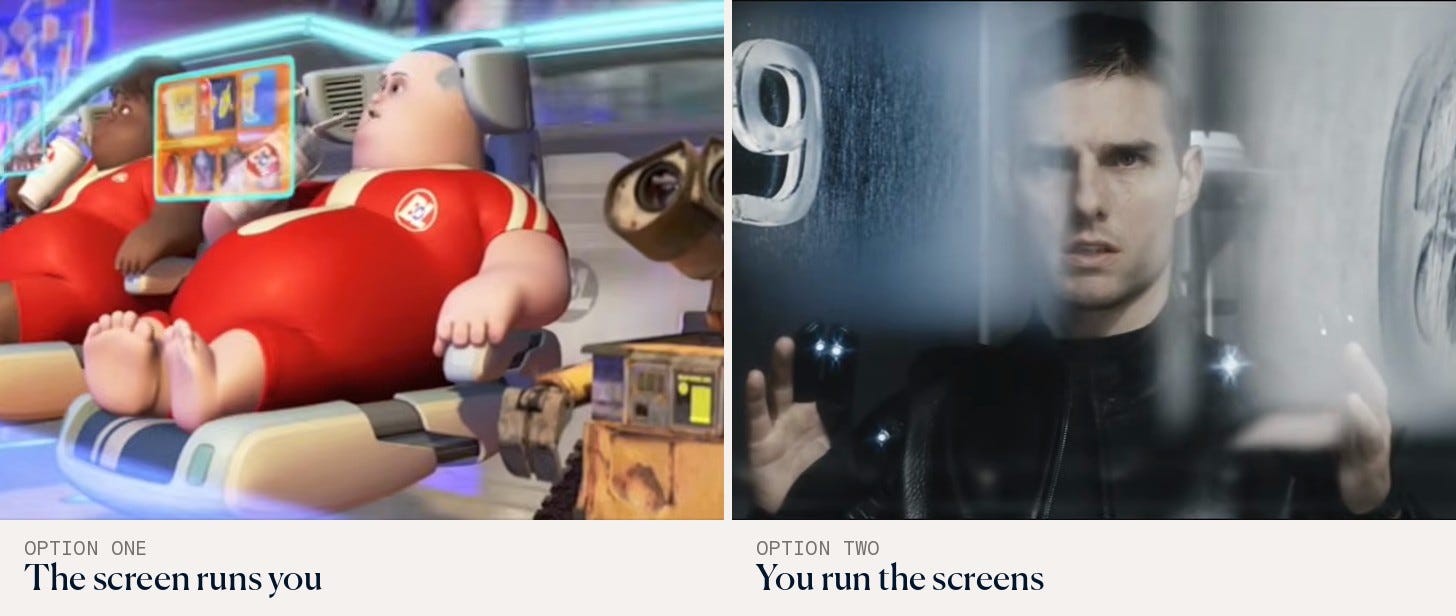
One way is to scroll TikTok, watch Netflix, and order Postmates with your savings.
You might still come out fine. Maybe your family, friends, and patrons look after you and value keeping you in a good life. Maybe SI makes the world so productive, and the distribution problem gets solved so well, that universal basic income or something like it delivers abundance to everyone. In that world, you could be better off than today without working hard at all.
But why roll the dice? The other way is to do everything in your power to position yourself for the future at its most extreme. If the extreme never arrives, you are still well positioned. If it does, you are ready.
The way out is through
Plenty of people want all of this stopped: banned, paused, regulated into the ground. Even inside the labs, more than 1,300 employees, including Anthropic's Dario Amodei, signed a statement called Pacing the Frontier, asking for an international effort to deliberately slow the most advanced systems while safety and oversight catch up.
There are good reasons to proceed with care. But look at the world we would be pausing into.
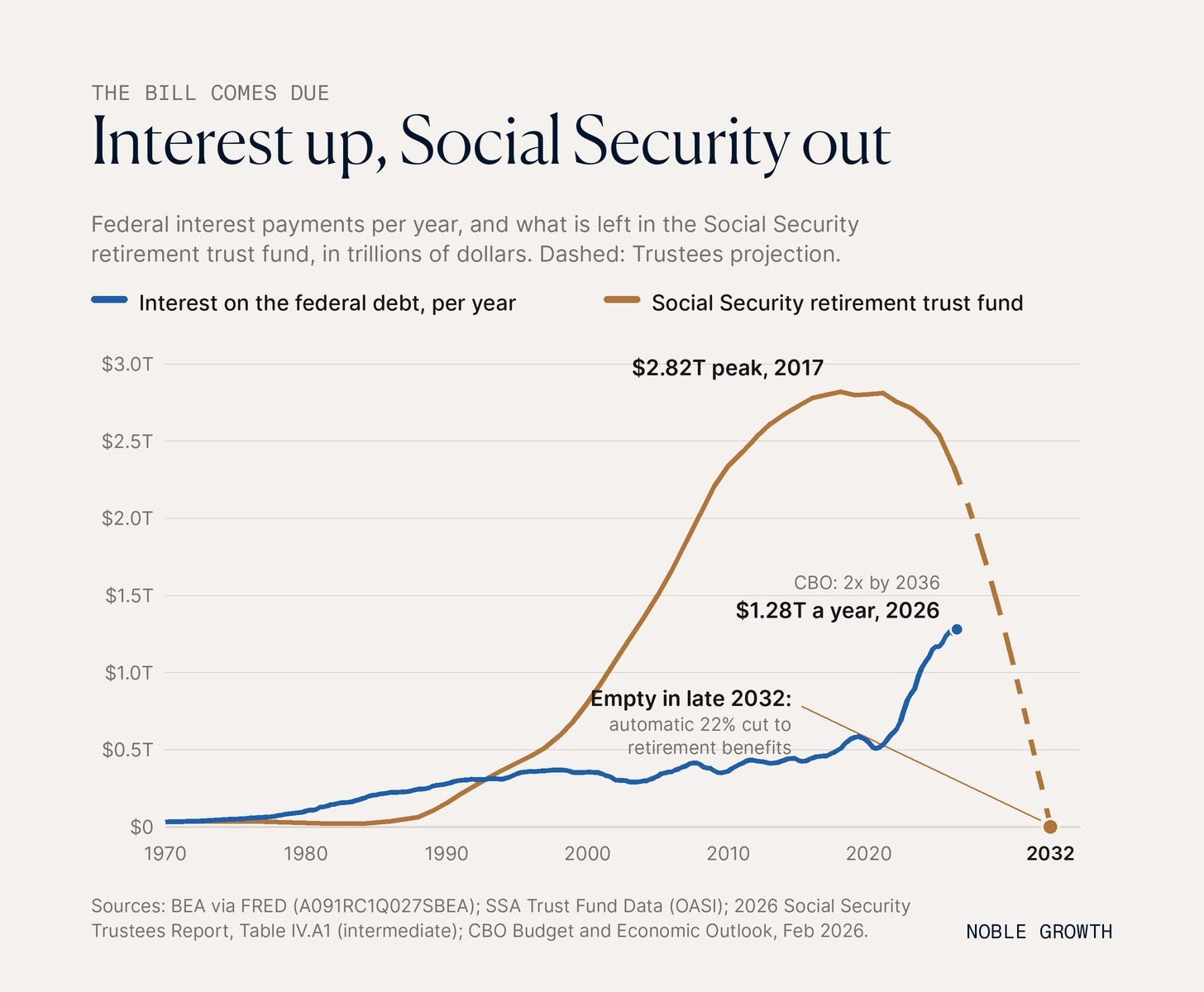
Federal debt held by the public is back near its post-World War II record of 106% of GDP, and the Congressional Budget Office projects 120% by 2036. The government now pays about $1.3 trillion a year in interest, a record share of the economy and more than the entire defense budget. The Social Security retirement fund runs dry in late 2032, triggering an automatic benefit cut of about 22 percent. Medicare's hospital fund follows in 2033.
The classic way out of a debt like this is to grow faster than it does, and that takes a productivity boom. Super Intelligence is the strongest candidate for one we have ever seen. Pause it, and the bill still comes due, with higher interest rates and less growth to pay it.
Younger people carry the heaviest load. They pay into Social Security with every paycheck, and in real terms they are unlikely to get back what they put in. For them, putting SI agents to work over the next ten years may be one of the only realistic ways to climb toward financial independence.
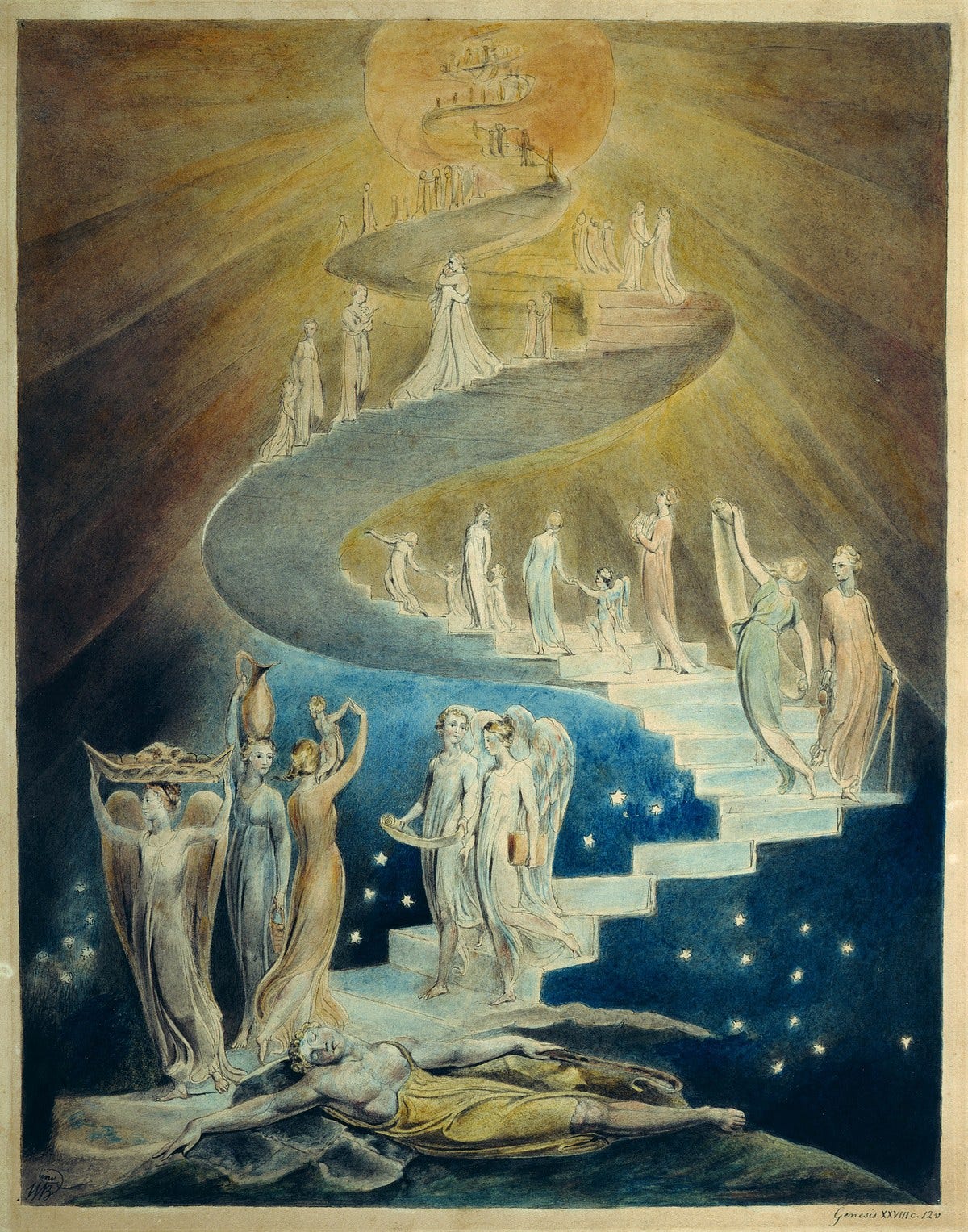
The way out is through. There is no putting the genie back in the bottle, even if we wanted to.
What still holds when software is free
If software becomes a commodity, what is left? Pieter Levels, the solo founder behind Nomads.com and Photo AI, recently laid out the moats he believes survive. There are six.
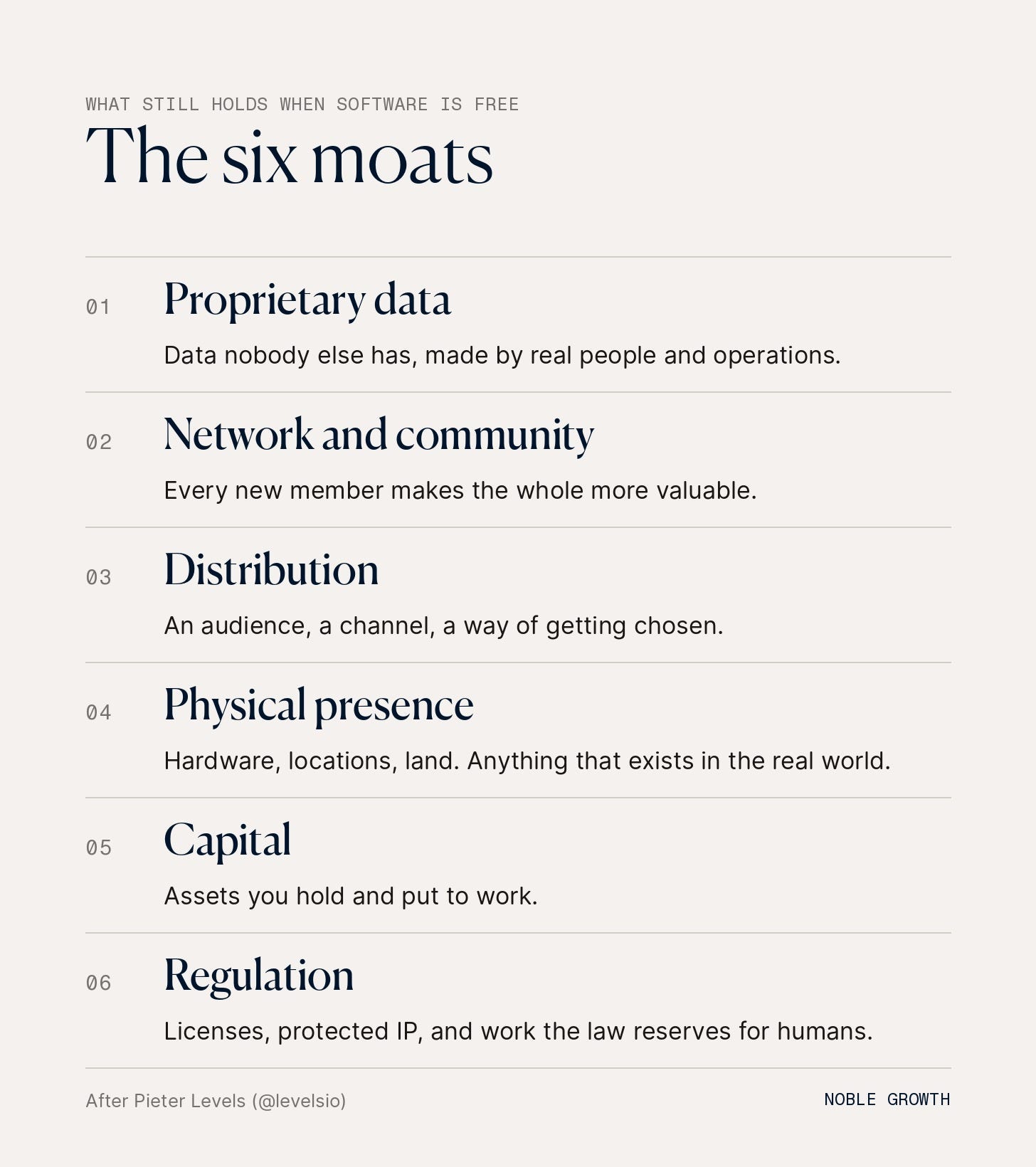
Distribution deserves special attention. When anyone can build anything, the scarce thing is getting chosen. That applies to people choosing what to buy, and more and more it applies to the AI agents doing the shopping on their behalf.
How Noble Growth is building for it
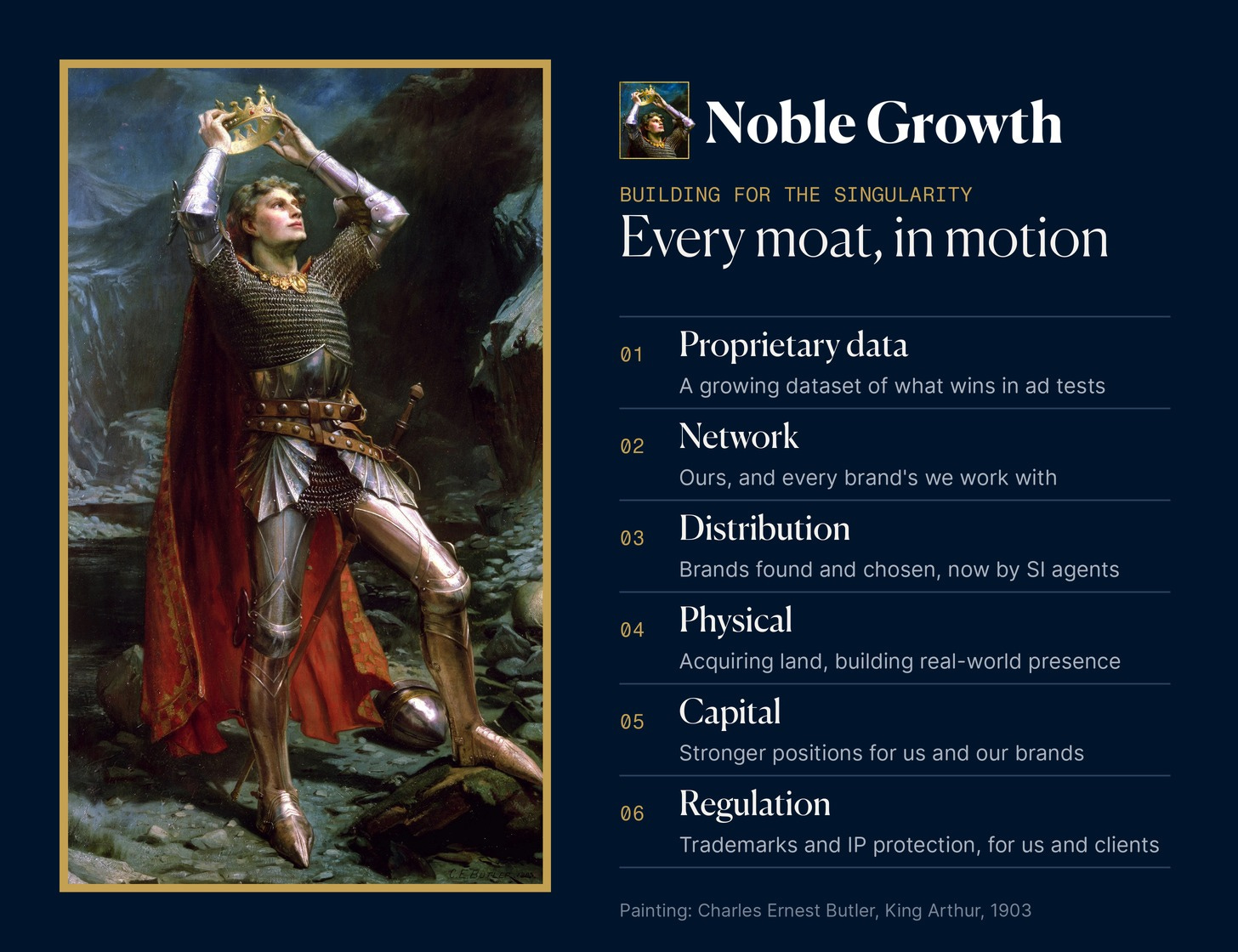
We have started positioning Noble Growth, and the brands we work with, for this world. One moat at a time:
Proprietary data. We are building a dataset of what works in ad testing to drive revenue across every kind of business and market sector, drawn from the tests we run.
Network. We are growing our own network and the networks of the brands we work with.
Distribution. It is the core of what we do: getting brands found and chosen. That now includes selling directly to AI agents. We have been building MCP connections that let a customer's agent find a partner's products and buy them, with no human required at checkout.
Physical. We are acquiring land and exploring real-world components of our work.
Capital. We are accumulating capital for ourselves and helping the brands we work with put theirs in the strongest position possible.
Regulation. We hold a federal trademark of our own and help clients protect their brands and intellectual property.
The time is now. The choice is yours.
If you'd like help mapping your brand's next ten years, reach out.
A closing note
So what role is left for humans if SI takes on nearly every task? The Matrix imagined us as batteries, harvested for power. A more hopeful picture: humans as the data. SI exists to serve what we need and want, and the only way to learn that is to watch us: our choices, our conversations, the signals we give off in every interaction.
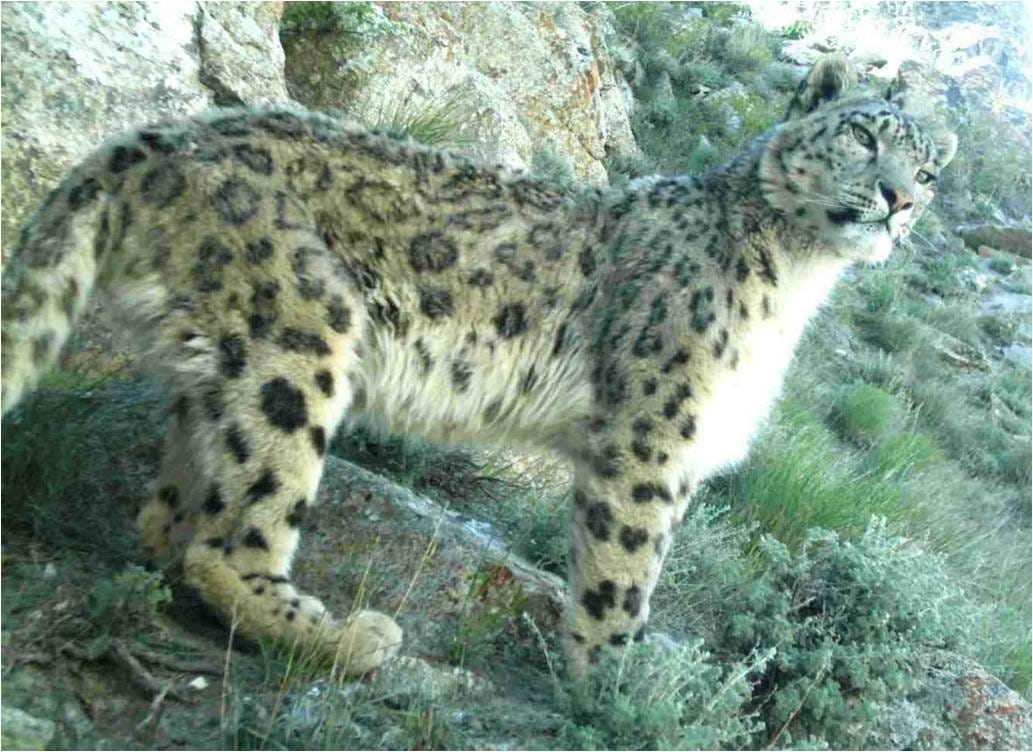
Think of researchers tracking snow leopards in the Himalayas, studying the animal in its own habitat to understand it. Now add one more design goal: the researchers' whole purpose is to care for the leopard, its cubs, and the mountains they live in. That is a far more optimistic future than The Matrix. It is also why proprietary data tops the list of moats.
Short of that extreme, some work will always be preferred done by a human. People will want a human priest, a human coach, a human at the head of the table.
Consider DJs. The craft was automated years ago. Software can beatmatch, mix, and play any setlist you program. Yet crowds still pack rooms to watch a human do it, even when the set is preset and the DJ is mostly jumping around on stage, vibing with them. In February, Calvin Harris played to 1.6 million people on a single São Paulo street, a Guinness World Record for a DJ set. People show up for the person.
Calvin Harris on Rua da Consolação, São Paulo, February 2026. Video: Music World Originals.
So the extreme case above is likely more extreme than what actually happens.
It is still a thought experiment worth running for every person alive today, especially the young, who have decades ahead of them as this future arrives.
"May you live in interesting times" is usually said as a curse. Read it again. Interesting times are when positions get made.
Our last post promised King Arthur would turn up in another ad you would recognize instantly. Here he is, recast into Guinness's 1999 "Surfer," shot for shot.
Guinness "Surfer", directed by Jonathan Glazer, was voted the greatest TV ad of all time in a 2000 Channel 4 and Sunday Times poll. Every wave, horse, cut and note of the soundtrack here is original. Only the hero changed, with no actors on camera.
How to use Higgsfield AI to make this film
The full workflow behind Reimagined No. 2: King Arthur recast into Guinness's 1999 "Surfer," shot for shot, in two days. Below: the tools and what they cost, the prompts, and the fix for every shot that fought back. Follow these steps to recast any classic ad the same way.